4  Bank Runs and Failures: Supplement

Detailed Empirical Evidence

Part 3: Fundamentals and Bank Failures

In theory, failures can be caused by either illiquidity or insolvency. Which type of failure is most empirically relevant? We now discuss the evidence on the causes of bank failures, organized through the lens of the conceptual framework above.

4.1 Aggregate and Narrative Evidence

4.1.1 The Great Debate: Friedman-Schwartz vs. Temin

The empirical debate on whether bank failures primarily stem from illiquidity or poor fundamentals goes back at least to the discussion of the causes of the Great Depression. The Great Depression featured roughly 9,000 bank failures, the largest wave in U.S. history.

Friedman and Schwartz (1963):

  • Many bank failures resulted from “self-justifying” runs that brought down illiquid yet solvent banks (i.e., \(\theta > \theta^{Solvency}\))
  • The failure of the Bank of the United States in December 1930 — the largest bank failure in history at the time — was caused by a run that brought down a “perfectly good bank” (Friedman, 1980)
  • The resulting loss of confidence was a key turning point in worsening the Depression

Temin (1976) and subsequent research:

  • Bank failures were largely caused by falling income and asset prices from the economic contraction, rather than exogenous panics
  • Wicker (1996, 2006) emphasizes the regional nature of runs and failures, generally concentrated in weak banks
  • The Bank of the United States had expanded rapidly in the 1920s, had unusually large real estate exposure, was engaged in inside lending and fraudulent deception, and examiners were aware of its weaknesses well before failure (Temin, 1976; Lucia, 1985; O’Brien, 1992)

4.1.2 Regional Evidence

A range of studies using regional data support the view that bank failures become more likely as fundamentals weaken:

  • Temin (1976): State-level regressions showing failures driven by falling income and asset prices
  • Alston, Grove, and Wheelock (1994): Agricultural conditions as a driver of bank failures
  • Wicker (1996, 2006): Runs and failures were regionally concentrated in weak banks, not indiscriminate

4.2 Bank-Level Evidence from Specific Episodes

Aggregate and regional evidence cannot reveal whether individual banks that were most likely to fail were weaker on fundamentals. Bank-level micro data provide sharper tests.

4.2.1 The Great Depression

The first systematic studies on historical U.S. bank failures using bank-level micro data are by White (1984), Calomiris and Mason (1997), and Calomiris and Mason (2003):

  • White (1984) shows that banks that failed during the 1930 banking crisis were less well capitalized than surviving banks, held more illiquid assets, and relied more on wholesale funding. Failures did not result from a discrete panic but from a continuation of fundamental weaknesses in the banking system, rooted in bad agricultural loans and undiversified portfolios.

  • Calomiris and Mason (1997), focusing on the June 1932 Chicago banking panic, find that banks that failed were weaker than surviving banks in terms of market equity values and balance sheet metrics. Failing banks were also more reliant on high-cost borrowing, even before the panic. While there were runs on both solvent and insolvent banks, the general runs did not cause the failure of solvent banks in this episode.

  • Calomiris and Mason (2003) document that most banks that failed throughout the Great Depression exhibited observable weaknesses in their balance sheets. Banking panics primarily accelerated the timing of failures among already weak banks, rather than causing the widespread collapse of otherwise solvent institutions.

4.2.2 The S&L Crisis and the 2008 Global Financial Crisis

Research on more recent episodes also finds that failures are strongly related to weak bank fundamentals:

  • Studies on the 1980s Savings and Loan Crisis and the 2008 Global Financial Crisis systematically find that banks that are highly levered, have low earnings and liquidity, and hold risky asset portfolios are more likely to fail (Cole and Gunther, 1995, 1998; Wheelock and Wilson, 2000; Berger and Bouwman, 2013).

  • The finding that poor fundamentals are necessary for failure in modern times is less surprising, given that deposit insurance reduces the scope for runs to cause failure. Nevertheless, the share of uninsured deposits has risen considerably in recent years (Hanson et al., 2024), making run risk relevant again.

4.2.3 Silicon Valley Bank and the 2023 Banking Turmoil

The runs on Silicon Valley Bank and other banks in March 2023 showed that runs are not a relic of history:

  • Jiang et al. (2024) and Metrick (2024): The banks that failed in March 2023 had suffered large asset losses on long-term securities holdings due to rising interest rates, pushing them toward insolvency.
  • Cipriani, Eisenbach, and Kovner (2024): Document runs on 22 banks during the 2023 turmoil. Runs were more likely at banks with weak fundamentals — both in terms of solvency and liquidity — and at banks with more granular deposits and a publicly observable stock price, consistent with a global game model.

Consistent with the historical evidence, the banks that failed in March 2023 had also suffered large asset losses, in this case on long-term securities holdings.

4.3 Broader Bank-Level Evidence: 160 Years of Data

In their companion paper, Correia, Luck, and Verner (2026a) bring together new systematic evidence from 160 years of micro-level U.S. data covering 1863–2024, based on a major data collection effort. This long sample covers 5,120 bank failures across a range of institutional and regulatory regimes — periods both with and without deposit insurance and a public lender of last resort.

4.3.1 Deteriorating Fundamentals Before Failure

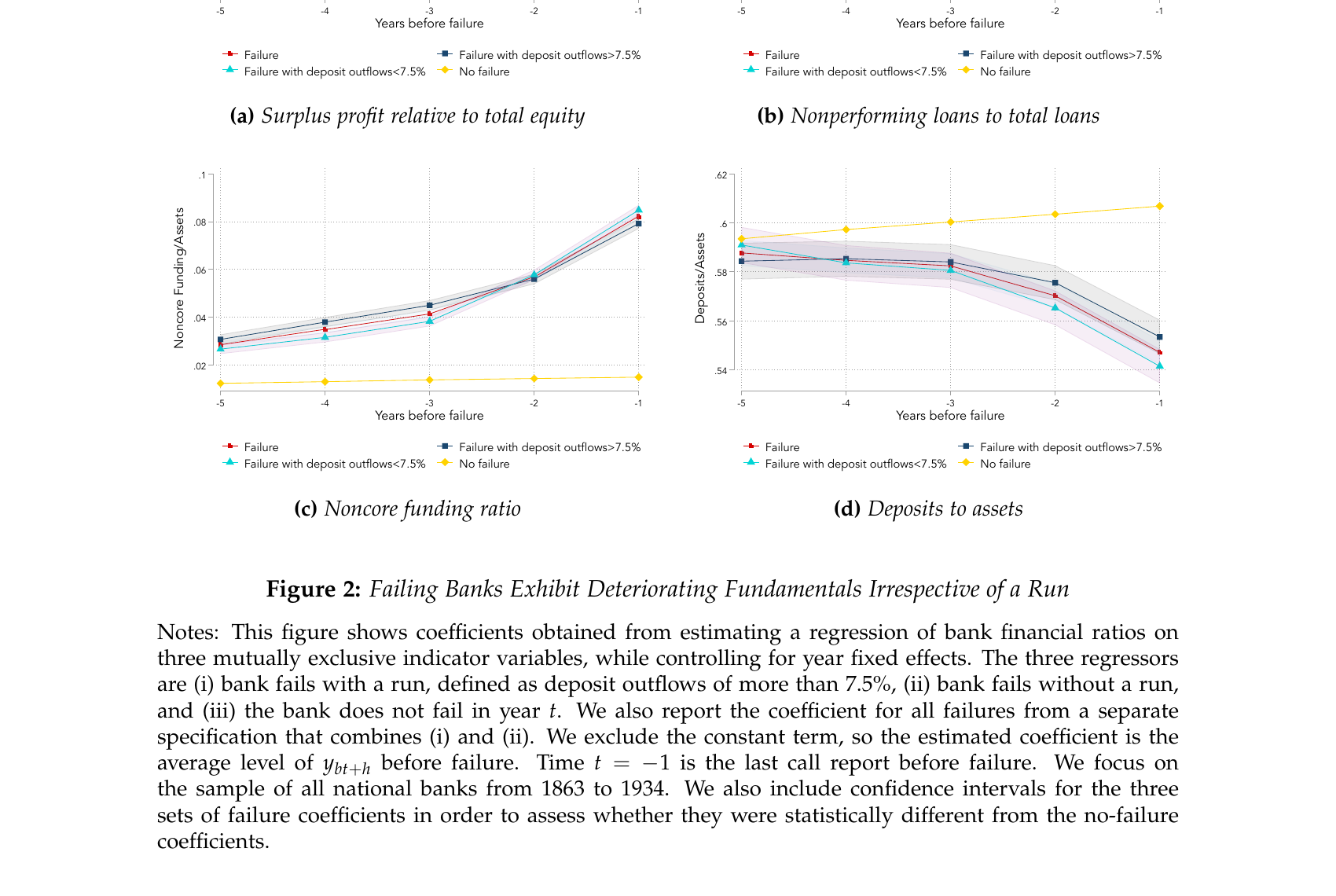
Figure 2 provides the most direct test of whether runs strike healthy or weak banks. Here we examine each panel in detail.

Figure 2: Failing Banks Exhibit Deteriorating Fundamentals Irrespective of a Run. Average bank financial ratios estimated from regressions with year fixed effects. Groups: failures with a run (deposit outflows >7.5%, red), failures without a run (blue/teal), surviving banks (yellow). Sample: national banks, 1863–1934. Source: Correia, Luck, and Verner (2026).
Figure 2 (Correia, Luck, and Verner, 2026): Panel-by-Panel Interpretation

What each panel shows — and why it matters:

Panel (a): Surplus profit / total equity — Profitability declines steadily for both failure groups starting five years before failure, while surviving banks (yellow) remain flat. By \(t = -1\), failing banks are far below survivors. The early and gradual decline rules out a sudden panic as the trigger.

Panel (b): Nonperforming loans / total loans — NPL ratios rise for both failure groups well before failure, accelerating sharply in the final two years. Deteriorating asset quality — not a coordination failure among depositors — is the proximate driver.

Panel (c): Noncore funding ratio — Failing banks increasingly substitute expensive noncore funding (time deposits, wholesale sources) for core deposits as losses mount. This is a symptom of desperation, not a cause: weak banks lose cheap funding and must replace it at higher rates, amplifying their distress.

Panel (d): Deposits to assets — Deposits drift gradually lower for failing banks over the full five-year window. This is not a sudden cliff — the slow bleed is consistent with “sleepy depositors” who are slow to react to deteriorating fundamentals.

The key finding: The red and blue lines are nearly indistinguishable across all four panels. Failures with runs look the same as failures without runs. Runs do not sort failures into a “healthier” group — banks that experienced large deposit outflows were just as fundamentally weak as those that did not. This directly contradicts the panic narrative, in which runs target otherwise sound banks.

4.3.2 Failures Are Predictable

Correia, Luck, and Verner (2026a) further show that bank failures are substantially predictable out-of-sample, both in the historical sample before deposit insurance and in the modern banking system. Aggregate waves of bank failures during banking crises are also predictable using micro-data on poor bank fundamentals.

Implication: Banking Crises Are Not Just “Bad Equilibria”

Banking crises with many failures should not be seen merely as unexpected jumps to bad equilibria; they largely reflect poor fundamentals. The substantial predictability of bank failures indicates that depositors were often slow to respond to bank weakness. This suggests a potentially important role for sleepy depositors who allow banks to be insolvent but remain liquid for a time, making failures more predictable — as outlined in Hypothesis 4.

4.4 Failures With and Without Runs

A necessary, but not sufficient, condition for a run to cause failure of a solvent bank is for deposits to actually flow out of the bank, forcing it to undertake value-destroying actions. Correia, Luck, and Verner (2026a) examine deposit outflows immediately before failure for all national bank failures from 1880 to 1934 and for all commercial bank failures from 1992 to 2024.

Comparison of Bank Failures Before and After Deposit Insurance
Feature Pre-FDIC (1880–1934) Post-FDIC (1992–2024)
Average deposit outflow before failure 14% 2%
Share of failures with deposit outflows >20% ~25% Rare
Prevalence of runs Common Rare (until 2023)
Primary resolution mechanism Run → receivership Supervisory closure
Fundamentals of failing banks Weak Weak

Before deposit insurance, the average failing bank lost 14% of its deposits before failure, and one-quarter of failures involved deposit outflows greater than 20%. After the founding of the FDIC, failing banks only lose around 2% of their deposits before failure. Deposit insurance has effectively transformed the mechanism of failure from market discipline (runs) to supervisory discipline (regulatory closure).

4.5 Weak Fundamentals and Bank Asset Booms

What causes weak bank fundamentals? Unexpected asset shocks — crop failures, real estate price declines, failure of a major borrower, or a local economic downturn — are typical drivers. In addition, the literature has identified another important precursor of poor fundamentals: rapid asset growth.

Rapid loan growth is often associated with rising bank leverage and future loan losses. Most of the major bank failures throughout U.S. history occurred after rapid, and arguably reckless, loan expansion:

  • Bank of the United States (1930): Rapid expansion in the 1920s
  • Franklin National Bank (1974): Aggressive growth
  • Continental Illinois (1984): Rapid loan growth
  • Washington Mutual (2008): The largest bank failure in U.S. history, preceded by aggressive mortgage lending
Credit Booms Predict Bank Failures

Consistent with these case studies, a large body of evidence using aggregate data finds that rapid expansion in credit is a strong predictor of banking crises (Schularick and Taylor, 2012; Baron and Xiong, 2017; Greenwood et al., 2022; Müller and Verner, 2023).

At the bank level, Fahlenbrach, Prilmeier, and Stulz (2018) use data from 1973 to 2014 and find that banks with rapid asset growth have lower future stock returns. Correia, Luck, and Verner (2026a) show that rapid loan growth is a strong predictor of bank failure in the next three-to-five years, especially in the post-WWII sample when banks were more unconstrained in their ability to grow.

This finding suggests that neglect of downside risks or governance problems can lead banks to take on excessive risks and grow too quickly when times are good, systematically leading to higher losses in bad times (Bordalo, Gennaioli, and Shleifer, 2018; Greenwood, Hanson, and Jin, 2026).

Part 4: Recovery Rates, Expert Assessments, and Mechanisms

4.6 Recovery Rates in Failure

The evidence reviewed so far overwhelmingly supports a link between bank failures and weak fundamentals. At the same time, pre-FDIC failures were commonly associated with runs. The evidence on weak fundamentals is not conclusive about whether failures primarily reflected runs on weak but solvent banks (\(\theta^{Solvency} < \theta < \theta^{Liquidity}\)) or on fundamentally insolvent banks (\(\theta < \theta^{Solvency}\)).

The framework in Section 2 suggests that one approach to make progress on this challenging question is to study recovery rates in failure. Specifically, Hypothesis 2 predicts that recovery rates for creditors are lower in fundamentally insolvent banks than in panic-induced failures.

4.6.1 Evidence on Recovery Rates

Correia, Luck, and Verner (2026a) exploit detailed information on receivership proceedings for all national bank failures from 1865 to 1934. A key challenge for interpreting recovery rates is that failure itself can reduce the value of bank assets — asset payoffs may be tied to bankers’ human capital and can thus be lower in receivership than in the hands of the banker. In our model, asset values fall by \(\rho\) in receivership, but \(\rho\) is unobservable.

However, in the context of national bank receiverships, receivers were required to liquidate assets in an orderly fashion and could not sell them without a court order. There is ample evidence that the OCC avoided fire sales into illiquid markets. Thus, the loss due to receivership is not necessarily large.

Creditor Recovery Rates and Asset Quality in National Bank Failures, 1865–1934 (Correia, Luck, and Verner, 2026)
Sample Avg. Recovery <50% [50,70%) [70,85%) [85,100%) ≥100% Good Doubtful Worthless N
All failures 0.75 0.16 0.20 0.22 0.21 0.19 0.36 0.47 0.18 2,935
Outflow < 7.5% 0.83 0.09 0.19 0.21 0.29 0.23 0.40 0.45 0.15 1,153
Outflow > 7.5% 0.72 0.20 0.23 0.26 0.19 0.12 0.33 0.49 0.20 1,599
What Recovery Rates Tell Us

Key findings:

  1. Average creditor recovery was only 75% of outstanding debt claims. Creditors experienced positive losses in 81% of failures.

  2. Recovery rates were even lower in failed banks with larger pre-failure deposit outflows (runs): 72% for banks with outflows >7.5% vs. 83% for those with smaller outflows. This is consistent with runs occurring in the weakest banks.

  3. OCC examiner assessments at the time of suspension: For the average failed bank, examiners assessed only 36% of assets as good, 47% as doubtful, and 18% as worthless.

Interpretation: Low recovery rates imply that most, but not all, banks that experienced a run and failed in the pre-FDIC era were fundamentally insolvent (\(\theta < \theta^{Solvency}\)), unless one assumes large value destruction from failure itself.

Under the extreme assumption of no failure-induced value destruction (\(\rho = 0\)), Correia, Luck, and Verner (2026a) calculate that 8% of pre-FDIC failures involved a run on a fundamentally solvent bank. Under the arguably equally extreme assumption that failure destroys 20% of bank value, the share rises to 22%.

Bottom line: Even before deposit insurance, runs on weak but fundamentally solvent banks likely accounted for a modest, though not negligible, share of failures.

4.7 Expert Assessments of the Causes of Bank Failures

Subjective assessments of the causes of bank failures by contemporary bank examiners provide additional insights into the roles of solvency and liquidity.

4.7.1 OCC Examiner Assessments

For all failed banks from 1865 through 1941, the OCC provided examiner assessments of bank asset quality at the time of suspension. As shown in the recovery rate table above, on-the-ground examiners inspecting bank assets believed that the typical failed bank held highly troubled assets, consistent with the low subsequent recovery on these assets. This holds both for banks subject to runs and for those that failed without a run. In fact, banks subject to runs were assessed as having slightly lower-quality assets than other failed banks.

4.7.2 Cause-of-Failure Classifications

For failures from 1865 through 1928, the OCC systematically provided bank-specific assessments of the cause of failure:

OCC Cause-of-Failure Classifications, 1865–1928 (Correia, Luck, and Verner, 2026a; Calomiris and Gorton, 1991)
Reported Cause of Failure Prevalence
Poor local economic conditions Most common
Asset losses (loan losses, depreciation) Very common
Fraud and insider abuse Common
Bank runs / illiquidity Fewer than 20 out of 2,000+
The Board of Governors’ Assessment (1936)

A report by the Board of Governors of the Federal Reserve System analyzing bank suspensions from 1892 through 1935 argues:

“In our long, failure-studded history of banking most of the institutions which suspended business were subsequently proved to be insolvent.”

The report goes on to argue that while the immediate trigger of failure is typically a lack of cash (in many cases from deposit outflows), this is not the root cause:

“While the loss of cash reserves is the immediate cause of the majority of suspensions it is not the fundamental or underlying cause. The loss of cash is something that can happen to almost any bank, and by the tenets of sound banking this contingency should be provided for in the loan, investment, and reserve policies. The inability to replenish cash reserves is a condition which arises from holding assets of an inferior quality — assets which cannot be sold without loss or used as collateral for borrowing.”

4.7.3 The Great Depression May Be Different

Richardson (2007) studies the classifications of bank suspensions from the Federal Reserve Board between 1929 and 1933, providing a more complete picture of bank failure during the Great Depression. These classifications indicate that asset losses were the primary source of bank distress. However, they also suggest that illiquidity may have played a larger role in bank failures during the Great Depression than during most other periods in U.S. history.

The notion that the Depression was “different” is also supported by econometric evidence in Correia, Luck, and Verner (2026a). They document an increase in excess failures at the height of the Depression, beyond what ex ante fundamentals can account for, potentially consistent with important roles for contagion and amplification through asset price declines.

4.8 Why Are Runs on Solvent Banks a Rare Cause of Failure?

A large body of empirical evidence indicates that fundamental insolvency, rather than illiquidity or depositor runs, is the dominant driver of bank failures. Runs can be an important trigger for the failure of insolvent institutions, but they less commonly cause the failure of fundamentally sound banks. This raises the question: Why do runs rarely cause solvent banks to fail?

4.8.1 Runs Are Not Confined to Insolvent Banks

One possible explanation is that only insolvent banks are subject to runs. This hypothesis, however, is not supported by the data. While runs are more likely in weak banks and after bad economic news, healthy banks can also be subject to runs.

Evidence That Runs Hit Both Weak and Strong Banks
  • Gorton (1988) and Calomiris and Gorton (1991): U.S. banking panics during the National Banking Era were predictable reactions to fundamental shocks that altered depositor perceptions of bank solvency.
  • Baron, Verner, and Xiong (2021): Using monthly data from banking crises in 46 countries since 1870, they find that banking panics were preceded by substantial declines in bank stocks, suggesting that panics occur following the realization of weak fundamentals.
  • Calomiris and Mason (1997): During the 1932 Chicago panic, both solvent and weak banks experienced runs, but only insolvent banks failed.
  • Correia, Luck, and Verner (2026b): Using textual analysis of newspaper articles to identify over 4,000 runs on U.S. banks from 1863 to 1934, they find that while runs were more likely in banks with weaker fundamentals, strong banks were also subject to runs, often in response to negative news about the banking system or economy. However, strong banks rarely failed following a run.

4.8.2 Mechanisms for Resolving Runs

The reason runs do not trigger failures of healthy banks is not that such runs do not occur. Rather, runs are often resolved by mechanisms other than fire sales, preventing inefficient failures of solvent banks, even absent government intervention.

1. Signaling Strength

Banks that survive runs are often reported to accommodate withdrawals to calm depositors. At the same time, banks often attempt to restore confidence by conspicuously delivering “truckloads of cash”. Cash could come from a new equity or debt injection from bank owners or other investors.

2. Suspension of Convertibility

In the historical U.S. banking system, more severe runs would lead banks to suspend convertibility, either partially or fully (Sprague, 1910; Gorton, 1985). Suspension was often undertaken jointly through local clearinghouse associations. Suspension allowed the clearinghouse and bank examiners to audit distressed banks and assess solvency. Banks that were deemed solvent were re-opened. Suspensions helped prevent unwarranted failures of solvent banks, but they could nevertheless lead to temporary disruptions for the local economy (Gorton, 2012).

3. Interbank Cooperation and Clearinghouse Certificates

In the era before the Federal Reserve, clearinghouses would act as quasi-central banks by issuing loan certificates, a joint liability of all members, to provide liquidity (Timberlake, 1984). In 1893 and 1907, clearinghouses issued small-denomination certificates directly to the public. Suspension and cooperation through clearinghouses could avoid destructive asset fire sales. This is consistent with Hypothesis 3: interbank liquidity provision reduces the scope for self-fulfilling runs.

4. Informed Depositors and Depositor Heterogeneity

Evidence suggests that interbank markets and other informed depositors can often discriminate between weak and strong banks:

  • Currie and Krost (1938): Deposit outflows during the Depression were mostly from large depositors — who tend to be more informed — while small retail depositors were less likely to withdraw
  • Saunders and Wilson (1996): Informed depositors could distinguish between failing and surviving banks during the Depression
  • O’Grada and White (2003): The Emigrant Industrial Savings Bank could withstand an unwarranted run by uninformed depositors in the Panic of 1854, but was forced to suspend convertibility in 1857 when the run was initiated by more informed depositors
  • Iyer and Puri (2012): Study a rumor-based run on an Indian bank and find that the bank survived not because of deposit insurance alone but because of long-standing depositor relationships and social networks

5. Strategic Complementarities and the 2014–2015 Greek Crisis

Artavanis et al. (2022): Decomposing Withdrawals

Using granular depositor-level data from the aftermath of the 2014–2015 Greek sovereign debt crisis, Artavanis et al. (2022) estimate that two-thirds of deposit withdrawals were driven by deteriorating fundamentals, while the remainder was due to strategic complementarities (i.e., depositors withdrawing because they expected others to withdraw).

This is one of the few studies that directly quantifies the relative importance of fundamental-based versus panic-based withdrawals. The finding that fundamentals dominate even in a severe crisis is consistent with the broader evidence reviewed here.

Taken together, the evidence across various settings suggests that strong banks can usually survive an unwarranted run, even in the absence of government support, through interbank linkages, relationships with their depositors, signaling strength, or, at worst, suspension. However, while interbank markets help banks insure against liquidity risk, they can also be a source of contagion (Allen and Gale, 2000; Iyer and Peydró, 2011; Mitchener and Richardson, 2019).
4.9 Government Interventions

4.9.1 Deposit Insurance

Deposit insurance crucially shapes the dynamics of bank failures and bank runs. As Figure 1 shows, although the FDIC era has witnessed major waves of bank failure (S&L Crisis, GFC), failures involving runs have become much less common.

Benefits of deposit insurance:

  • Eliminates runs as a trigger mechanism
  • Insured depositors have no incentive to run
  • Reduces contagion across banks
  • Prevents the most destructive bank failures

Costs of deposit insurance:

  • Removes market discipline by depositors
  • Creates moral hazard: insured banks may take excessive risks (Calomiris and Jaremski, 2019)
  • Shifts failure mechanism from runs to supervisory closures, expanding scope for regulatory forbearance (Kane, 1989)
  • Insured deposits may flow to weaker banks (Martin, Puri, and Ufier, 2023; Cucic et al., 2024)

In the modern banking system, bank failures are usually supervisory decisions rather than market-driven events (Correia, Luck, and Verner, 2025). Supervisory discipline is valuable in the absence of market discipline, as deposit insurance can allow failing banks to operate longer than optimal.

4.9.2 Lender of Last Resort

The model above suggests that liquidity should be provided to solvent banks subject to runs (\(\theta > \theta^{Solvency}\)) whenever there is no functioning interbank market. This reflects the logic underlying the famous Bagehot (1873) doctrine: to contain a panic, a central bank should lend freely to solvent institutions against collateral at high rates.

Richardson and Troost (2009): A Natural Experiment

Richardson and Troost (2009) exploit a natural experiment during the Great Depression based on the differential discount window lending policy of the Atlanta and St. Louis Federal Reserve banks.

Banks in the Atlanta Fed’s jurisdiction, which championed generous liquidity support, experienced significantly fewer suspensions, better lending conditions, and quicker economic recovery, particularly during the 1930 panic.

The evidence supports the notion that central bank liquidity provision effectively mitigated banking panics — consistent with the Bagehot doctrine and Hypothesis 3.

4.9.3 The Limits of Liquidity Support

International evidence indicates, however, that preventing panics is insufficient to avoid the adverse consequences of crises:

  • Baron, Verner, and Xiong (2021) use a cross-country panel to study banking crises with and without panics. Even when policies forestall runs, “quiet crises” — banking sector distress without panics — result in severe contractions of credit and output.

  • Baron et al. (2024) show, using data on policy interventions, that while aggressive liquidity interventions can be helpful, they typically produce only modest, short-lived increases in the market value of bank stocks. Liquidity interventions cannot reverse the long-run undercapitalization that follows substantial equity losses.

The Central Policy Implication

Because banking crises are typically rooted in solvency problems, they cannot be mitigated by liquidity policy alone. Policies focused on maintaining and restoring bank solvency — through adequate capital requirements, prompt corrective action, and recapitalization when needed — are necessary for preventing the most adverse consequences of banking crises. Both liquidity and solvency tools are essential.

4.10 Empirical Evidence on Liquidity Mismatch and Fragility

Before concluding, we note important evidence on how liquidity mismatch affects bank fragility in the modern era, which complements the historical evidence reviewed above.

4.10.1 Chen, Goldstein, Huang, and Vashishtha (2022)

Chen, Goldstein, Huang, and Vashishtha provide the first broad-based empirical evidence linking bank fragility to liquidity transformation, using the universe of U.S. bank data from 1993 to 2016.

Key findings:

  1. Uninsured deposits are flighty: Uninsured deposit flows respond negatively to poor bank performance
  2. Liquidity mismatch amplifies fragility: Banks with higher CatFat (more liquidity creation, as measured by Berger and Bouwman, 2009) exhibit significantly stronger sensitivity of uninsured deposit outflows to bad performance
  3. Insured vs. uninsured: The pattern is reversed for insured deposits — banks raise insured deposits to offset the loss of uninsured ones, though not enough to fully compensate
  4. Systematic shocks are especially dangerous: The amplification effect of liquidity mismatch is almost five times stronger for economy-wide shocks than for bank-specific shocks, consistent with the strategic complementarities channel
Connecting to the Extended Framework

These findings provide direct evidence for the strategic complementarities identified in Extended Prediction 3 above:

  • Chen et al.’s CatFat measure captures the strategic complementarity term \(D^UF/D\) from the Jiang framework: high CatFat ≈ illiquid assets funded by runnable deposits ≈ strong complementarities ≈ low \(s^*\)
  • The finding that higher CatFat amplifies outflow sensitivity is evidence that the run threshold \(s^*\) is lower for banks with more liquidity mismatch
  • The 5× amplification for systematic shocks confirms Jiang’s prediction that monetary tightening (which reduces \(\theta_S\) for all banks) creates correlated fragility that is qualitatively different from idiosyncratic asset losses
  • The reversal for insured deposits (\(D^I\)) confirms the structural prediction: insured depositors are passive and do not enter the strategic complementarity term. Moving deposits from \(D^U\) to \(D^I\) raises \(s^*\) without changing fundamentals

This distinguishes panic-based runs from pure fundamental runs: if runs were purely fundamental-based, the degree of liquidity mismatch (and hence the strength of strategic complementarities) should not affect outflow sensitivity.

Summary

4.11 Key Takeaways

Main Insights
  1. Solvency is the primary driver of bank failures: Throughout 160 years of U.S. banking history, bank failures are essentially always associated with weak fundamentals — low capitalization, poor asset quality, declining profitability, and reliance on expensive funding

  2. Runs are triggers and accelerators, not root causes: Runs commonly triggered the failure of already insolvent banks in the pre-deposit-insurance era. But runs rarely caused the failure of fundamentally sound banks, because solvent banks could resolve runs through interbank borrowing, suspension, signaling, and depositor relationships

  3. Recovery rates confirm fundamental insolvency: Average creditor recovery of only 75% in failed banks suggests that most failures involved genuine insolvency, not just illiquidity

  4. Bank failures are predictable: Observable fundamentals can predict failures out-of-sample, both before and after deposit insurance. Banking crises should not be viewed merely as random jumps to bad equilibria

  5. Credit booms are warning signs: Rapid asset and loan growth systematically precede bank failures and banking crises

  6. Deposit insurance changed the mechanism, not the cause: After the FDIC, runs became rare, but solvency-driven failures continued. The failure mechanism shifted from market discipline (runs) to supervisory closure

  7. Both liquidity and solvency policies are essential: Liquidity support (LOLR) can prevent panic-driven failures of solvent banks but cannot address the fundamental solvency problems that drive most bank failures. Capital requirements and prompt recapitalization are indispensable

  8. The Great Depression may be partially different: While solvency problems dominated even during the Depression, there is evidence of excess failures beyond what fundamentals can explain, consistent with contagion and amplification effects

4.12 References

4.12.1 Primary Source

  • Correia, S., Luck, S., & Verner, E. (2026). Bank failures: The roles of solvency and liquidity. Annual Review of Financial Economics, forthcoming.

  • Correia, S., Luck, S., & Verner, E. (2026a). Failing banks. Working paper.

  • Correia, S., Luck, S., & Verner, E. (2026b). Bank runs. Working paper.

4.12.2 Theoretical Foundations

  • Drechsler, I., Savov, A., Schnabl, P., & Wang, O. (2025). Deposit franchise runs. Journal of Finance, forthcoming.

  • Diamond, D. W., & Dybvig, P. H. (1983). Bank runs, deposit insurance, and liquidity. Journal of Political Economy, 91(3), 401-419.

  • Goldstein, I., & Pauzner, A. (2005). Demand deposit contracts and the probability of bank runs. Journal of Finance, 60(3), 1293-1328.

  • Morris, S., & Shin, H. S. (2003). Global games: Theory and applications. In Advances in Economics and Econometrics, Cambridge University Press.

  • Rochet, J. C., & Vives, X. (2004). Coordination failures and the lender of last resort: Was Bagehot right after all? Journal of the European Economic Association, 2(6), 1116-1147.

4.12.3 Historical Evidence

  • Friedman, M., & Schwartz, A. (1963). A Monetary History of the United States, 1867-1960. Princeton University Press.

  • Temin, P. (1976). Did Monetary Forces Cause the Great Depression? Norton.

  • White, E. N. (1984). A reinterpretation of the banking crisis of 1930. Journal of Economic History, 44(1), 119-138.

  • Calomiris, C. W., & Mason, J. R. (1997). Contagion and bank failures during the Great Depression. American Economic Review, 87(5), 863-883.

  • Calomiris, C. W., & Mason, J. R. (2003). Fundamentals, panics, and bank distress during the Depression. American Economic Review, 93(5), 1615-1647.

  • Richardson, G. (2007). Categories and causes of bank distress during the Great Depression. Explorations in Economic History, 44(4), 586-607.

  • Richardson, G., & Troost, W. (2009). Monetary intervention mitigated banking panics during the Great Depression. Journal of Political Economy, 117(6), 1031-1073.

4.12.4 Modern Evidence

  • Chen, Q., Goldstein, I., Huang, Z., & Vashishtha, R. (2022). Liquidity transformation and fragility in the US banking sector. Journal of Finance, 77(4), 2001-2057.

  • Jiang, E., Matvos, G., Piskorski, T., & Seru, A. (2024). Monetary tightening and U.S. bank fragility in 2023: Mark-to-market losses and uninsured depositor runs? Journal of Financial Economics, 159, 103899.

  • Cipriani, M., Eisenbach, T. M., & Kovner, A. (2024). Tracing bank runs in real time. Working paper, Federal Reserve Bank of New York.

  • Baron, M., Verner, E., & Xiong, W. (2021). Banking crises without panics. Quarterly Journal of Economics, 136(1), 51-113.

  • Fahlenbrach, R., Prilmeier, R., & Stulz, R. M. (2018). Why does fast loan growth predict poor performance for banks? Review of Financial Studies, 31(3), 1014-1063.

  • Artavanis, N., Paravisini, D., Robles-Garcia, C., Seru, A., & Tsoutsoura, M. (2022). Deposit withdrawals. Working paper.

4.12.5 Policy and Regulation

  • Bagehot, W. (1873). Lombard Street: A Description of the Money Market. Henry S. King.

  • Calomiris, C. W., & Jaremski, M. (2019). Stealing deposits: Deposit insurance, risk-taking, and the removal of market discipline in early 20th-century banks. Journal of Finance, 74(2), 711-754.

  • Berger, A. N., & Bouwman, C. H. S. (2009). Bank liquidity creation. Review of Financial Studies, 22(9), 3779-3837.

  • Schularick, M., & Taylor, A. M. (2012). Credit booms gone bust: Monetary policy, leverage cycles, and financial crises, 1870–2008. American Economic Review, 102(2), 1029-1061.

  • Hanson, S. G., Kashyap, A. K., & Stein, J. C. (2024). The demise of the bank funding advantage. Working paper.